Published: 2026-04-02 | Updated: 2026-04-02
Freediving Breathing Training
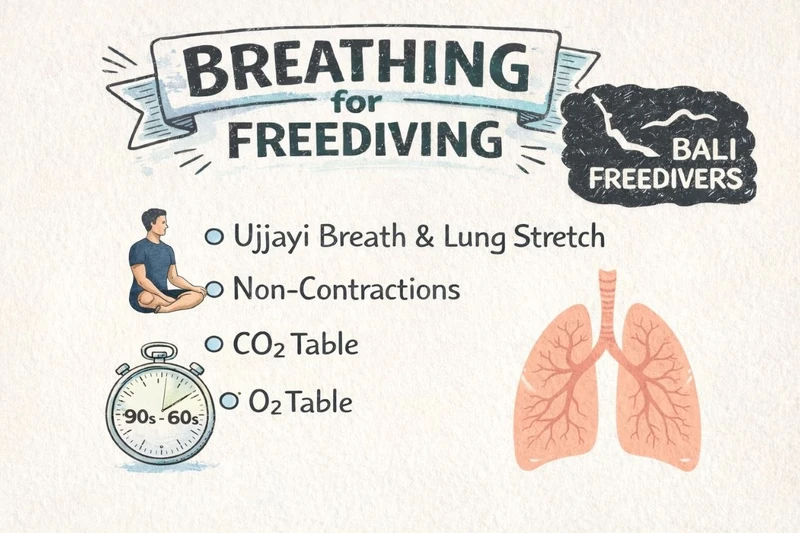
This breathing preparation guide is intended for dry training only. The exercises should be performed on dry land and not in water. Some of the exercises may cause dizziness. Therefore, it is recommended to perform the exercises in a seated position on a soft surface in a safe environment.
1. Full Lungs Inhale (Capacity & Control)
A powerful and effective inhale is the basis for every dive, enabling the diver to store the maximum amount of oxygen prior to descent. This requires the diver to have the power and flexibility in the diaphragm and the rib cage. Breathing also helps to relax the diver and avoid unnecessary exertion in the process.
Training Structure
a) Ujjayi Breath
- Sit with straight spine, chin slightly down
- Inhale and exhale through slightly constricted vocal cords
- Inhale diaphragm first, then chest
- Count: ~10 (diaphragm) + 5 (chest)
- Maintain for at least 5 minutes
b) Full Lungs Stretch
- Max inhale, then hold breath
- Perform gentle stretches:
- Arms overhead (arrow position)
- Side bends (one arm up)
- Spine twists
- Hold each stretch up to 30 seconds
- Repeat each 3 times, seated, without strain
2. CO₂ Tolerance
CO2 tolerance is how comfortable you are during breath-holds, especially when you feel the urge to breathe. Most discomfort during early training results from increasing CO2 levels and not oxygen depletion. Increasing CO2 tolerance enables you to hold your breath for longer periods in a calm and controlled manner.
Training Structure
a)Static CO₂ Tables
- Find your max breath-hold → divide by 2 for working time
- Example: 3:00 max → 1:30 holds
Protocol:
- 1 minute relaxed breathing
- (90s hold / 90s rest) × 10 rounds
- Optional: reduce rest by 10s each round
- Optional: perform on exhale for increased difficulty
- Intensity: moderate (not maximal, not easy)
b)Active CO₂ Tables
- Same timing principle as static tables
- Add movement: walking, cycling, squats, pulling
- Simulates real diving stress and urge to breathe while moving
- Can be done on land without a buddy
- In water → always train with a buddy
3. Non-Contractions Breath Holds
Non-contraction training helps in the development of the capacity to be in a state of relaxation in the early and middle phases of the breath-hold. This improves mental efficiency and the capacity to recognize inner sensations.
Training Structure
Non-Contraction Holds (5 steps):
- Take a relaxed full inhale and hold breath seated or lying down
- Relax the entire body (face, jaw, neck, shoulders, abdomen)
- Observe sensations without reacting or tensing
- End the hold before strong contractions begin
- Rest with relaxed breathing and repeat for 4–8 rounds
4. O₂ Tolerance Tables
O2 tolerance training aims to condition the body to function with less oxygen. This will be necessary for deeper dives and longer bottom times. O2 tolerance training conditions the body to function in a hypoxic state. While CO2 training conditions the body to function in a state where there is more carbon dioxide than usual, O2 tolerance training conditions the body to function in a state where there is less oxygen than usual.
O2 tables are advanced freediver tables, as they bring you closer to hypoxia, increasing the risk of blackout if not controlled. CO2 tolerance should be mastered first for beginners, as initial breath-holding difficulties tend to be CO2-related, not O2-related. CO2 tolerance should be mastered first, then O2 tables can be introduced.
Training Structure
O₂ Tables (5 steps):
- Relaxed breathing for 1–2 minutes to prepare
- Perform breath-holds at 60–75% of max breath-hold
- Keep breath-hold duration constant across sets
- Gradually reduce rest time between holds (e.g., 2:00 → 1:50 → 1:40…)
- Complete 6–8 rounds, stopping before excessive fatigue or dizziness